
In food and beverage production plants, sudden spikes in turbidity of the processing water supply are a leading cause of complete failure of the mixing tanks. A ruptured fine filter membrane allows suspended microparticles to enter the production process, causing denaturation and sedimentation of the product. This situation results in losses of hundreds of millions of dong for each batch of goods that are discarded and disrupts the production line.
This bottleneck stems from intermittent measurements using outdated equipment with drifting calibrations. Additionally, fluctuating results between shifts pose a risk of failing ISO 22000 or HACCP audits.
Therefore, inspectioncheck water turbidity bassassinate TCVN 6184:2008This is a core solution for protecting production flows 24/7. This article analyzes the ISO 7027 optical turbidity monitoring and suspended particulate matter counting solution distributed by Duc Duong.

1. Risk of leakage of filter media particles and defective batches
1.1 Consequences of feedwater turbidity surges on the blending batch
A broken sand filter column or punctured cartridge membrane releases millions of microscopic particles of silt and sediment into the water supply. When this turbid water enters the mixing tanks for beer, soft drinks, or fish sauce, the microscopic particles react, dissolve, and form a layer of sediment at the bottom of the packaging.
As a consequence, the company had to destroy all the product tanks worth hundreds of millions of dong. Furthermore, the disruption to the inventory disposal process delayed deliveries and resulted in contractual penalties.
(Read more: Electrochemical digitalization solution for industrial wastewater treatment)
1.2 Standards for turbidity of processing water according to QCVN 01-1:2018/BYT
According to QCVN 01-1:2018/BYT, Food production water standards stipulate that the turbidity index of clean water used for processing purposes must not exceed 2 NTU. For bottled water or beer production lines, the required water quality is strictly 0.5 NTU.
Maintaining turbidity control according to TCVN 6184:2008 (ISO 7027:1999) helps the factory ensure compliance with food safety standards. This is an important legal basis when receiving HACCP and FSSC 22000 audit teams.
2. Control of optical turbidity according to ISO 7027
2.1 90° Scattering Technology with Hanna HI88713 Turbidity Meter
To standardize the QC process, the factories are implementing… methods for measuring water turbidityUsing 90-degree Nephlometric light scattering technique. Distributed by Duc Duong. Turbidity meter according to ISO 7027 standard.Hanna HI88713 is an officially imported product.
The device utilizes an 860 nm infrared LED light source, completely eliminating the color absorption of the sample. Wide measurement range.From 0.00 to 1000 NTU with an accuracy of +- 2%Immediate detection of suspended particulate matter exceeding the threshold.
(Read more: Optimizing accuracy in aquaculture water testing: Solutions from photometers and multi-parameter meters.)
| Optical Index | Sensory Turbidity Measurement / Used Equipment | Hanna HI88713 ISO 7027 Turbidity Meter |
| Light source | Tungsten lamps (Affected by sample color) | 860 nm infrared LED (No color interference) |
| Sensor angle | Transparency measurement at 180 degrees (High error margin when drilling slightly) | 90-degree Nephlometric Scattering (Accuracy +- 2%) |
| Benchmark calibration | Single-point calibration is prone to discrepancies between cases. | Multipoint calibration Formazin (0, 15, 100, 750, 1000 NTU) |
| Data retrieval | Handwritten notes (Easy to jump between shifts) | Automatic and transparent GLP-compliant log tracking. |
2.2 Automatic GLP log logging to prevent benchmark drift.
The Hanna HI88713 system incorporates detailed GLP (Good Laboratory Practice) data storage. The device automatically records time, date, and calibration data from standard Formazin cuvettes.
This feature helps eliminate subjective errors between work shifts. Transparent record keeping provides reliable digital evidence for ISO 22000 audits.
3. In-depth monitoring of suspended particulate matter in the laboratory.
3.1 Separation of suspended particulate matter with Klotz Syringe Particle Counter
Although the NTU turbidity index reflects the overall water quality, photometric measuring devices cannot differentiate the size of suspended microparticles. To performcurrent microparticle controlDuc Duong provides in-depth expertise. Syringe liquid particle counter (KLOTZ – Germany)Combine with SW-CA 3.0 software.
The LDS 30/30 laser sensor accurately analyzes microscopic ranges.t from 1.5 – 50 umThe system detects early signs of microparticle leakage from the filter membrane before the water’s NTU level spikes in the production line.
(Read more: Standards for distilled water used in laboratories according to TCVN 4851)
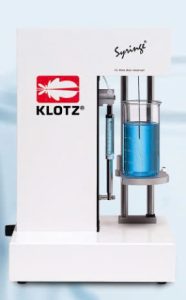
A particle counter helps to accurately analyze fine particulate matter in measuring water turbidity
3.2 Audit Trail Encryption Keys according to Standard 21 CFR Part 11
The SW-CA 3.0 software controlling the Klotz Syringe machine fully complies with FDA 21 CFR Part 11 regulations. Audit Trail logs are automatically encrypted on SQL Server, completely preventing data modification.
Data integrity protection solution for food QC stations. This transparency helps factories eliminate concerns about errors in records during inspections.
Does your company need advice on planning a water quality monitoring station for food-grade water to meet ISO 7027/ISO 22000 standards and receive a free IQ/OQ/PQ assessment document? Click here. Contact Form for Duc Duong CompanyLet our application engineering team provide immediate support.
4. Standardize the ultrapure water used for rinsing the blank floor.
4.1 Eliminating Cuvette Background Noise with the EVO UP DIO BA System
The distilled water used to rinse the cuvette contains suspended impurities that create false background turbidity (> 0.05 NTU), distorting the initial blank test. This distortion causes the 0 NTU calibration process to continuously report errors.
To standardize the water used for flushing floors, Duc Duong distributes EVO UP DIO BA ultra-pure water filtration systemofficial channels Mirae ST Korea Official.
The output water reaches electricity.The resistivity is 18.2 MO Mega.cm at 25°C and the TOC index is < 5 ppb.Water quality standard type 1 according to TCVN 4851:1989 (ISO 3696:1987) completely eliminates background noise during photometric measurements.
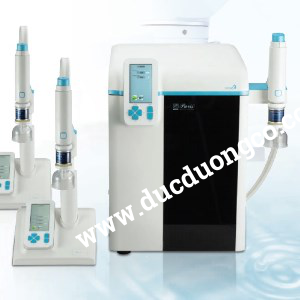
The water purifier produces ultra-pure water for use during the rinsing process and measures the turbidity of the water
4.2 Optimization of the flushing reaction for pipes and sensors
Use ultrapure water in the automatic flushing cycle.RinseThis helps to thoroughly clean and eliminate microparticles adhering to the cuvette and tubing. A clean optical surface helps maintain high precision for measurements.
The stability of the wash water enhances repeatability between analysis sessions. Technicians have complete control over the quality of the feedwater on a daily basis.
5. Solutions to dispel fears of “air bubbles causing NTU readings to jump”
5.1 Control of suspended air bubbles and cuvette maintenance procedures
Air bubbles suspended in the feedwater sample are the main cause of erratic NTU readings on the display. The foam discharge feature on the Klotz Syringe piston pump, combined with the settling mode on the Hanna HI88713, eliminates 100% of air bubble interference.
At the same time, fingerprints or scratches on the cuvette wall are remedied with specialized silicone oil. Proper cuvette cleaning technique ensures that the NTU reading remains stable.
5.2 Commitment to readily available spare parts and 24-hour on-site technical support.
Duc Duong alleviates concerns about measurement interruptions due to burnt-out LED lamps by having spare parts readily available in Ho Chi Minh City. We always have standard Formazin cuvettes and replacement LED lamps in stock.
Our team of application engineers, knowledgeable in ISO 7027 standards, is committed to providing on-site technical support within [number] days.24 hours. CThis commitment ensures that the factory’s QC station maintains continuous operation.
6. The ROI problem and the ISO/IEC 17025 documentation
6.1 The ROI problem of extending the lifespan of fine filter membranes
When defending the equipment budget before the CFO, the return on investment (ROI) is the most solid financial indicator. The investment cost for the metering station is significantly less than the P&L loss.One mixing tank was destroyed due tosudden increase in turbidity.
The system helps engineers accurately determine when to replace the filter membrane.30% lengthOPEX filter life. The project achieved a break-even ROI in just [timeframe].within 9 to 12 months.
6.2 Standardizing the entire ISO/IEC 17025 audit documentation
Duc Duong provides a complete set of Installation Validation (IQ), Operational Validation (OQ), and Performance Validation (PQ) documentation, along with calibration certificates compliant with ISO/IEC 17025. The analysis procedures are pre-established according to ISO 7027 standards.
Transparent, digitized evidence is readily available for ISO 22000, HACCP, and FSSC 22000 audit teams. The documentation confirms our ability to control the quality of processed water to international standards.
Conclude
In short, process automationmeasuring water turbidity according to ISO 70The integrated suspended particulate monitoring system (27) is a strategic step that helps Food & Beverage factories eliminate the risk of batch spoilage and protect production 24/7. The synchronized equipment chain includes a Hanna HI88713 turbidity meter, a Klotz Syringe particle counter with SW-CA 3.0 (Germany), and an EVO UP DIO BA water filtration system. This system accurately measures turbidity at 90 degrees with a ±2% scattering, purifies water to Type 1 18.2 MOmega.cm, and analyzes suspended particulates according to 21 CFR Part 11 standards. The system completely eliminates the fear of air bubbles causing NTU readings, extends OPEX membrane lifespan by 30%, delivers a break-even ROI of 9-12 months, and completes the ISO/IEC 17025 accreditation process. Duc Duong is proud to be a trusted partner distributing high-quality food QC station equipment through official channels.
Customers who require consultation on planning a turbidity and particulate matter monitoring station for food-grade water, meeting ISO 7027 / ISO 22000 standards, and wish to receive a quote for genuine equipment, please contact and register at DUC DUONG SCIENCE AND TECHNOLOGY COMPANYTo receive attentive service.
FAQ
1. What is the Net Turbidity (NTU) value according to ISO 7027 standards for food production?
According to QCVN 01-1:2018/BYT and TCVN 6184:2008 (ISO 7027:1999), the turbidity of clean water used for food processing must not exceed 2 NTU. For high-purity production lines such as beer and soft drink blending, this indicator is usually strictly required at <= 0.5 NTU.
2. Why is the 90° light scattering method on the Hanna HI88713 instrument superior to older measuring instruments?
Nephlometric technology, compliant with ISO 7027, uses an 860 nm infrared LED source to measure a 90-degree scattering angle, completely eliminating the influence of solution color. The device provides an accuracy of +- 2% and displays results in stable NTU/FNU units.
3. What additional benefits does incorporating a Klotz Syringe particle counter bring to a food processing plant?
The turbidity meter provides only an overall NTU reading, while the Klotz Syringe precisely analyzes the density of each size range of suspended microparticles (1.5 – 50 µm). This combination allows for early detection of membrane leaks or tears before the water becomes excessively turbid.
4. How can I eliminate air bubbles that cause the NTU reading to fluctuate when measuring turbidity?
The reciprocating piston pump on the Klotz Syringe incorporates an automatic foam discharge process. Simultaneously, the Hanna HI88713 features an intelligent settling counter, allowing air bubbles to escape completely before reading the optical scattering signal.
5. What documentation does Duc Duong Company provide for turbidity measurement stations to meet ISO/IEC 17025 standards?
Duc Duong provides a complete package of Installation Validation (IQ), Operational Validation (OQ), Performance Validation (PQ) documentation, national/NIST standard Formazin solution calibration certificates, and commits to on-site technical support at the factory within 24 hours.