
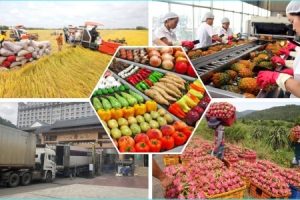
In international agricultural trade, having containers rejected or returned from import ports represents a critical financial risk for businesses. Numerous shipments of coffee, rice, and cashews have faced destruction due to Aflatoxin levels exceeding permissible limits following sea transport.
These issues often stem from errors during manual sampling—specifically, taking samples from the surface that fail to represent the more humid product located beneath. Phenomena such as density-based stratification of the grains can skew results regarding moisture content and mycotoxin levels.
Consequently, investing in equipment to standardize the separation process in accordance with TCVN 13052:2021 is essential for safeguarding export shipments. Utilizing automatic grain sample dividers—combined with the cleaning and drying systems supplied by Duc Duong—effectively eliminates the risk of contract liability.
1. Risks of liability for breach of agricultural produce contracts
1.1 Impact of Aflatoxin mold during sea transport
Residual moisture in agricultural produce creates an ideal environment for *Aspergillus flavus* spores to proliferate and produce Aflatoxin. Under the standards set by the European Food Safety Authority (EFSA), levels of this toxin are strictly regulated at extremely low limits due to its high biological toxicity.
During long-haul sea transport, atmospheric moisture condensation within the container can trigger rapid mold growth on produce that has not been sufficiently dried. If the initial test sample fails to accurately reflect the actual moisture content of the entire shipment, there is a significant risk that the importing port will confiscate the cargo.
1.2 Financial losses and the risk of contractual penalties
When a shipment of agricultural produce is refused entry, the exporter faces a “double financial blow.” Costs associated with demurrage, return freight, and product disposal can amount to tens of billions of VND.
Even more serious, the producer’s brand risks being flagged by international partners for potential quality violations, thereby jeopardizing opportunities to secure major commercial contracts in the future.
2. Standardizing the grain sample splitting process
2.1 Eliminating grain stratification with the Pfeuffer Model 32 Sample Divider
Manual sample splitting methods—such as the quartering technique—inherently suffer from mechanical grain stratification based on density. Larger, heavier, and moister grains tend to settle at the bottom, compromising the absolute representativeness of the resulting test sample.
To address this source of error, Duc Duong distributes the Pfeuffer Model 32 grain sample divider (manufactured in Germany), which splits samples into 32 smaller portions.
| Technical Criteria | Manual Cone-and-Quartering Method | Pfeuffer Model 32 Sample Divider |
| Sample homogeneity | Inconsistent (5–10% error margin) | Perfectly homogeneous (matches original batch 100%) |
| Separation mechanism | Manual action (operator-dependent) | Rotary division (32-position) |
| Particle segregation | Significant occurrence (based on particle density) | Completely eliminates particle segregation |
| Standards compliance | Difficult to meet ISO/IEC 17025 requirements | Complies with TCVN 13052 / ISO 24333 |
The continuous rotary tube splitting principle divides a large bulk sample into 32 smaller subsamples, each maintaining a perfectly uniform particle composition. This solution ensures that the analytical sample accurately reflects the quality characteristics of the entire shipment.
2.2 Dust-resistant splitting slots and germ protection
The conduit and splitting slot system of the Pfeuffer Model 32 is constructed from precision-machined stainless steel. The inclined wall design facilitates smooth grain flow, preventing jams or damage to the grain germ.
Anti-adhesive material prevents the accumulation of dust and debris between splitting cycles. This feature ensures measurement repeatability that meets the stringent requirements of ISO/IEC 17025 accreditation.
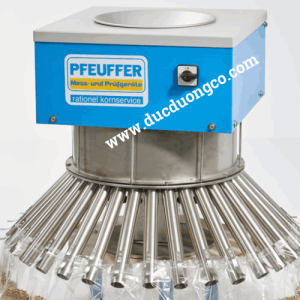
The Pfeuffer grain sample divider helps effectively homogenize agricultural product samples
3. Separation of coarse dust and defective grains
3.1 Automating the grain cleaning process with the Pfeuffer MLN
Following homogeneous sample splitting, the sorting of defective grains, shriveled grains, and dust is a mandatory step for determining impurity levels. Manual sorting takes 1 to 2 hours per batch, creating a bottleneck in the inspection process and delaying the release of cargo vehicles.
Duc Duong offers the Pfeuffer MLN grain cleaning solution, featuring technical data synchronization with the official Pfeuffer MLN system.
The unit integrates an exhaust fan to separate light dust with a vibrating perforated screen system to sort out impurities. This grain cleaning machine automatically and completely separates small stones, straw, and broken kernels.
3.2 Rapid processing capacity: 30 to 60 seconds per batch
The operating speed of the Pfeuffer MLN allows for the complete processing of a 0.5–1 kg agricultural grain sample in just 30 to 60 seconds. This efficiency enables laboratories to reduce sample preparation time by 80% compared to manual methods.
The impurity sorting results achieve absolute accuracy. This data empowers Procurement Managers to make transparent and rapid decisions regarding contract pricing.
Are you looking for a solution to set up an automated agricultural grain sample processing system compliant with ISO/IEC 17025 standards, or do you wish to receive a quote for genuine Pfeuffer (German) equipment? Please click the Duc Duong Company Contact Form to consult with our team of application engineers immediately.
4. Convection drying for moisture determination
4.1 Critical moisture control with the Jeiotech OF4-15VW convection drying oven
Determining moisture content is the final critical parameter before issuing container sealing certificates. Moisture measurement via the heat-drying method requires strict temperature control to ensure complete water evaporation without scorching organic matter.
Duc Duong supplies the OF4-15VW forced-convection drying oven (windowed model), featuring technical specifications directly from the manufacturer, Jeiotech Korea.
A forced-convection fan maintains temperature uniformity within the drying chamber to within ±0.5°C. Multi-directional hot airflow ensures precise, thorough moisture removal, meeting rigorous TCVN and ISO standards.
4.2 Design of a viewing window for real-time drying process monitoring
The inclusion of an insulated tempered glass window allows technicians to easily observe the condition of the sample particles inside the drying chamber. This feature eliminates the need to open the door, thereby preventing the loss of internal heat.
Avoiding thermal shock ensures the high reliability of moisture measurements. Accurate moisture data serves as valuable evidence to protect shipments against quality-related claims.
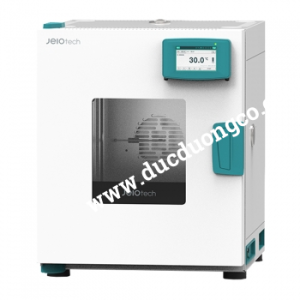
Laboratory drying ovens help ensure the quality of agricultural products for export
5. Solutions to Eliminate “Lab Bottleneck” Fears
5.1 Resolving Bottlenecks in Container Loading Schedules
A major concern for Lab Managers is that complex sample processing can delay container loading and shipment schedules. The combination of Pfeuffer and Jeiotech automation equipment reduces the total time required for raw sample separation and analysis by 80%.
The microprocessor-based PID sensor in Jeiotech drying ovens eliminates concerns regarding moisture measurement errors caused by temperature drift. Test data achieves 100% repeatability, ensuring data integrity.
5.2 Commitment to Genuine Spare Parts and 24-Hour On-site Technical Support
To address concerns about equipment breakdowns and the lack of replacement parts for imported machinery, Duc Duong maintains a local inventory of genuine spare parts (perforated sieves, exhaust fans, sensors) in Ho Chi Minh City.
Our team of application engineers commits to providing on-site technical support within 24 hours of any issue arising. This commitment ensures the continuous operation of the factory’s agricultural grain testing lines.
6. ISO/IEC 17025 & TCVN Compliance Documentation
6.1 IQ/OQ/PQ Validation Documentation for Agricultural Labs
QA Managers often worry about the regulatory compliance of equipment documentation during certification audits. All equipment supplied by Duc Duong comes with a complete set of Installation Qualification (IQ), Operational Qualification (OQ), and Performance Qualification (PQ) documentation. Temperature mapping (9–12 points) demonstrates that the drying oven maintains temperature uniformity within ±0.5°C, enabling laboratories to easily meet TCVN 13052 and ISO/IEC 17025 standards.
6.2 Standardizing traceability data for inspection agencies
The system digitizes all logs regarding sample splitting, impurity classification, and moisture drying. Continuous 24/7 data logging ensures full compliance with laboratory Data Integrity requirements.
Transparent records are readily available for presentation to inspection teams from BOA or international bodies such as SGS and Vinacontrol, helping businesses affirm the quality and credibility of their shipments in the market.
Conclusion
Eliminating the risk of agricultural export rejections requires a technological shift from manual sample splitting to automated analysis systems. The integrated solution—comprising the Pfeuffer Model 32 grain sample splitter, Pfeuffer MLN grain cleaner, and Jeiotech OF4-15VW convection oven—ensures 100% sample representativeness, reduces processing time by 80%, and precisely controls moisture to eliminate Aflatoxin-producing mold. This equipment system completely resolves laboratory bottlenecks, prevents errors caused by grain stratification, and facilitates the compilation of comprehensive ISO/IEC 17025-compliant validation records. Duc Duong is proud to be a trusted partner supplying high-quality, comprehensive agricultural testing equipment.
For consultation on solutions for processing agricultural export grain samples and to receive a quote for genuine German-made Pfeuffer equipment, please contact Duc Duong Scientific and Technical Company.
DUC DUONG SCIENTIFIC & TECHNICAL COMPANY
Address: 1014/67 Tan Ky Tan Quy, Binh Hung Hoa, Binh Tan, HCMC
Tel: (028) 3762 8042 – 3762 8043 – 3750 8514 – 3750 8793
Fax: 028 37628043
Email: ducduong@ducduongco.com
Website: ducduongco.com
Zalo OA: DUC DUONG SCI
FAQ
1. Why does the manual “quartering” method for agricultural grain samples result in significant error?
The manual quartering method relies entirely on human sweeping force, leading to mechanical stratification (where larger/heavier grains and impurities fall first). Consequently, the surface sample does not accurately reflect the true quality and moisture content of a batch weighing hundreds of tons.
2. How does the Pfeuffer Model 32 grain sample divider handle grain jamming?
The Pfeuffer Model 32 features precision-machined, high-grade stainless steel chutes and divider slots set at an incline. Grain flows continuously via gravity without jamming, dust accumulation, or germ damage, evenly splitting the bulk batch into 32 uniform subsamples.
3. How long does the Pfeuffer MLN grain sample cleaner take to process a 1 kg sample?
The Pfeuffer MLN integrates a gentle dust extraction fan and an automated perforated sieve system to separate shriveled grains and small stones from a 1 kg sample in just 30–60 seconds. This speed allows laboratories to reduce processing time by 80% compared to manual impurity removal.
4. How does the Jeiotech OF4-15VW forced-convection drying oven ensure temperature uniformity?
The Jeiotech OF4-15VW utilizes a forced-convection fan combined with an advanced PID microprocessor controller. The system maintains chamber temperature uniformity within ±0.5°C, ensuring complete moisture evaporation from the grains without scorching or altering their composition.
5. What validation documentation does Duc Duong provide for agricultural inspection laboratories seeking ISO/IEC 17025 accreditation?
Duc Duong provides a comprehensive documentation package—including Installation Qualification (IQ), Operational Qualification (OQ), and Performance Qualification (PQ) protocols, temperature mapping (9–12 points), and equipment calibration certificates—ready to support ISO/IEC 17025 accreditation assessments by bodies such as BOA, SGS, Vinacontrol, or Cafecontrol.