
In the high-tech aquaculture and export processing supply chain, even minor errors in reading water quality parameters can lead to severe consequences. Aquatic species may suffer from water shock or toxicity (due to NH3/NO2- levels), resulting in mass die-offs. Furthermore, containers of frozen seafood risk being rejected and returned by US or EU ports if residual chlorine levels exceed permissible limits.
The root cause lies in the reliance on visual colorimetric methods for water quality testing, which are prone to inaccuracies caused by ambient lighting conditions. Additionally, water temperature fluctuations—rising from 25°C in the morning to 32°C at midday—can cause baseline shifts in pH and toxic ion readings.
Consequently, there is a need to fully digitize aquaculture water testing processes in strict compliance with standards QCVN 02-19:2019/BNNPTNT and QCVN 01-1:2018/BYT. This article introduces specialized optical and electrochemical measurement solutions from Duc Duong, designed to automate temperature compensation and ensure absolute accuracy.
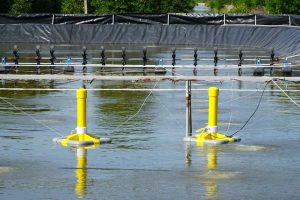
1. Risks associated with water quality fluctuations
1.1 Harmful effects of NH3 and NO2 toxins and residual chlorine from treatment
Toxic outbreaks in the culture pond environment directly impact the survival rate of the aquatic stock. According to aquatic toxicology studies, free ammonia (NH3) concentrations exceeding 0.05 mg/L cause hepatopancreatic necrosis in shrimp. Meanwhile, nitrite (NO2-) levels exceeding 1.0 mg/L induce “brown blood syndrome,” leading to respiratory distress in shrimp and fish.
For processing plants, residual chlorine levels in the water used to wash raw materials must be controlled in accordance with QCVN 01-1:2018/BYT. If free chlorine residues exceed 0.5 mg/L, chemical residues will be detected in the product during export inspection.
1.2 Financial losses and the risk of losing export licenses
Failure to detect fluctuations in water quality parameters in a timely manner can result in severe financial losses for businesses. High-tech shrimp farms risk losing tens of billions of VND overnight due to environmental shock affecting the shrimp.
For processing companies, seafood shipments found to contain chemical residues face confiscation at the port of entry. Such incidents can lead to the loss of export certification for demanding markets such as the US, the EU, and Japan.
2. Optical digitization of parameters
2.1 Eliminating visual error with the Hanna HI83306 Photometer
Visual colorimetric methods using standard test kits carry significant risks due to variables such as the angle of outdoor sunlight and technician eye fatigue. Consequently, estimated results often deviate from actual concentrations by 20% to 30%.
To completely eliminate subjective visual assessment, Duc Duong distributes officially imported Hanna environmental photometers, featuring technical data fully synchronized with the manufacturer, Hanna Instruments Indonesia.
| Comparison Criteria | Manual Test Kit Color Comparison Method | Hanna Digital Photometer |
| Color density determination mechanism | Human visual estimation | Optical sensor with calibrated-wavelength LED |
| Measurement accuracy | High margin of error (20–30%) | High digital precision |
| Outdoor environmental impact | Significant variance based on light angle | Unaffected by ambient light |
| Data storage | Manual record-keeping | Automatic storage of 500 GLP-compliant data points |
The specialized photometer utilizes a standard-wavelength LED light source combined with optical interference filters. It automatically converts color density into digital readings, directly displaying values for NH3, NO2-, PO4^3-, and Fe.
2.2 Ensuring measurement repeatability in compliance with ISO/IEC 17025
Switching to a digital photometric method eliminates result discrepancies between different laboratory shifts. All measurements yield consistent values that align closely with the established calibration curve.
The device’s high precision and repeatability fully meet data traceability criteria. This facilitates the laboratory’s efforts to finalize validation documentation in accordance with ISO/IEC 17025 standards.
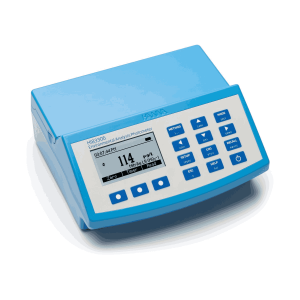
Hanna’s environmental photometers effectively support water quality testing in aquaculture
3. Controlling Chlorine Residue and pH
3.1 Ensuring Data Transparency with Specialized Chlorine Meters
Controlling residual chlorine in the water supply for processing plants requires measuring equipment with a wide range and high sensitivity. Duc Duong supplies genuine meters for free and total chlorine (0.00 to 10.00 mg/L).
Using specialized chlorine meters with a range of 0.00 to 10.00 mg/L and an accuracy of ±0.03 mg/L ensures transparent testing data. This allows QA Managers to easily monitor the disinfection process for water used to wash seafood prior to freezing.
3.2 Automatic Temperature Compensation (ATC) to Prevent pH/ISE Calibration Drift
Fluctuations in water temperature—rising from 25°C in the morning to 32°C at midday—can cause measurement potential drift, leading to inaccurate readings of pH and toxic ion concentrations. To effectively address this issue, Duc Duong distributes the Hanna HI98191 pH/ORP/ISE/Temperature meter, featuring official data connectivity from Hanna Instruments Global.
This pH/ORP/ISE meter series integrates a microprocessor-based sensor with Automatic Temperature Compensation (ATC). This technology automatically calculates and compensates for temperature variations, ensuring absolutely stable pH and toxic ion concentration readings in brackish or saline water environments.
To receive a comprehensive digital solution for seafood water testing that meets ISO/IEC 17025 standards, and to get a quote for genuine Hanna equipment, please click the Duc Duong Company Contact Form to receive immediate assistance from our team of engineers.
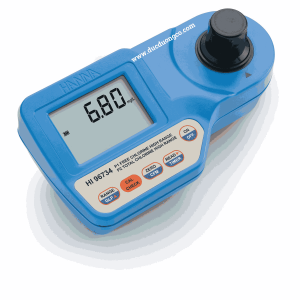
Chlorine meter for aquaculture water testing
4. Measure ISO standard NTU turbidity
4.1 Quantify suspended biomass using Hanna HI93703 Turbidity Meter
Turbidity directly affects the ability of sunlight to penetrate, determining the photosynthesis of algae populations in ponds. The method of measuring clarity using the Secchi disc is subjective and cannot distinguish between suspended clay particles and algal biomass.
Duc Duong brings the solution of Hanna ISO standard turbidity meter synchronizing official parameters Hanna HI93703 Official.
The turbidity meter utilizes an 890 nm infrared light beam, adhering to the ISO 7027 standard. It accurately quantifies turbidity levels ranging from 0.00 to 1000 NTU, enabling pond managers to adjust algae density effectively.
4.2 Balancing algae density and pond microorganisms
Precise NTU monitoring allows aquaculture engineers to accurately calculate the dosage of water-treatment microorganisms. This prevents the risk of sudden algae crashes caused by insufficient light for photosynthesis.
Protecting beneficial algae populations helps maintain stable dissolved oxygen (DO) levels, ensuring the pond environment remains in an optimal biological balance for the aquatic stock.
5. Eliminating the fear of “electrode failure”
5.1 Eliminating concerns about ion interference with Double Junction technology
A major concern for farm managers is sensor fouling—caused by ion interference or biofilm accumulation in brackish or saltwater environments—which leads to measurement drift. The Hanna electrodes distributed by Duc Duong utilize Double Junction technology, effectively preventing contamination of the internal reference electrolyte.
Additionally, the CAL Check feature automatically verifies the cleanliness of the electrode surface prior to measurement. The system issues an alert if it detects electrode fouling or cross-contamination of calibration buffers.
5.2 Commitment to spare parts availability and 24-hour on-site technical support
Beyond equipment durability, concerns regarding spare parts shortages are alleviated by Duc Duong’s after-sales policy. We maintain readily available stocks of standard solutions (pH, Chlorine, NTU) and genuine replacement electrodes in Ho Chi Minh City.
Our team of experienced application engineers is committed to providing on-site technical support within 24 hours. This commitment ensures the continuous operation of water quality control processes at both the farm and the processing plant.
6. ISO/IEC 17025 & QCVN Compliance Documentation
6.1 IQ/OQ/PQ Validation Documentation for Aquaculture Water Testing Equipment
To facilitate quality inspections, water testing equipment must possess complete legal documentation. The Hanna equipment suite supplied by Duc Duong comes with a full set of Installation Qualification (IQ), Operational Qualification (OQ), and Performance Qualification (PQ) documentation.
ISO 7027 light source certification and calibration certificates accompanying the device ensure full regulatory compliance. This data enables Quality Assurance (QA) managers to readily substantiate results during QCVN inspections.
6.2 GLP-Compliant Digital Data Traceability for Inspections
The equipment supports the storage of 200 to 500 GLP-compliant data records and features an integrated USB port for direct data transfer to a computer. This capability ensures data integrity by preventing manual data tampering.
Transparent digital data records allow businesses to readily present evidence during audits. Consequently, processing plants can easily pass international certification assessments such as ASC, BAP, or GlobalGAP.
Conclusion
Optimizing accuracy in aquaculture water testing is a core solution that enables farming and processing enterprises to eliminate risks associated with stock mortality due to water shock and the rejection of export shipments. The integrated solution suite—comprising the Hanna HI83306 multiparameter photometer, a chlorine meter, the HI98191 pH/ORP/ISE meter, and the HI93703 ISO-compliant turbidity meter—facilitates a 100% digital transition, Automatic Temperature Compensation (ATC), and absolute precision in controlling NH3 and NO2- toxicity. This system eliminates concerns regarding calibration drift or salinity electrode failure while providing comprehensive IQ/OQ/PQ validation documentation that meets ISO/IEC 17025 and QCVN requirements, as well as international export standards such as ASC, BAP, and GlobalGAP. Duc Duong is proud to be a trusted partner providing comprehensive water testing solutions for the aquaculture industry.
For consultation on digital solutions for aquaculture water testing and to receive a quote for genuine Hanna equipment, please contact Duc Duong Scientific & Technical Company to receive dedicated service.
DUC DUONG SCIENTIFIC & TECHNICAL COMPANY
Address: 1014/67 Tan Ky Tan Quy, Binh Hung Hoa, Binh Tan, HCMC
Tel: (028) 3762 8042 – 3762 8043 – 3750 8514 – 3750 8793
Fax: 028 37628043
Email: ducduong@ducduongco.com
Website: ducduongco.com
Zalo OA: DUC DUONG SCI
FAQ
1. Why are manual colorimetric drop-based test kits prone to errors when measuring aquaculture pond water parameters?
Drop-based test kits rely heavily on the angle of natural outdoor sunlight and human visual fatigue. This can lead to discrepancies of 20% to 30% in NH3 and NO2- readings, preventing pond managers from timely detecting and addressing toxic outbreaks.
2. How does the Automatic Temperature Compensation (ATC) feature on the Hanna HI98191 multiparameter meter work?
The ATC feature utilizes a temperature sensor built directly into the electrode. When the sample water temperature fluctuates throughout the day (e.g., between 25°C and 32°C), the microprocessor automatically calculates and compensates for potential errors, ensuring 100% stable pH and ISE ion concentration readings.
3. Which key physicochemical parameters in aquaculture water can the Hanna HI83306 multiparameter photometer measure?
The Hanna HI83306 photometer uses a standardized LED light source to precisely measure core biochemical parameters—including NH3, NO2-, PO4^3-, Fe, Cu, alkalinity, and residual chlorine—and displays digital readings, completely eliminating the need for subjective visual estimation.
4. Why should the ISO-compliant Hanna HI93703 turbidity meter be used instead of a Secchi disk?
A Secchi disk only measures apparent surface clarity and is susceptible to interference from shadows or wave action. The Hanna HI93703 turbidity meter emits an 890 nm infrared beam in accordance with the ISO 7027 standard, allowing for the precise quantification of suspended particles (NTU) to accurately manage algal biomass and pond microorganisms.
5. What support does Duc Duong provide to ensure Hanna water testing equipment operates stably without calibration drift?
Duc Duong offers comprehensive solutions, including readily available calibration standards (pH, Chlorine, NTU) and genuine double-junction replacement electrodes (resistant to salt poisoning) in Ho Chi Minh City, backed by a commitment to on-site technical support from application engineers within 24 hours.