
In the quality assessment of sterile pharmaceuticals, laser sensor drift is a potential hazard hindering inventory clearance. When the background voltage changes, the optical system will report inaccurate particle impurity density readings (>= 10 µm and >= 25 µm). This problem can easily lead to the suspension of shipment of injectable drug batches or failure to obtain GMP-EU certification during the cGMP Audit.
The core bottleneck lies in the manual calibration data storage process, which lacks transparency and faces the risk of data integrity errors according to international regulations. Furthermore, the cell membrane used for measurement is highly susceptible to clogging when in contact with highly viscous infusion samples.
That’s whySo, the processCalibration of particle measuring equipmentheartm TCVN ISO/IEC 17025:2017This is a mandatory requirement of the Validation department. This article guides you through the 5-step digital calibration standardization process on the Syringe Klotz liquid particle counter distributed by Duc Duong.
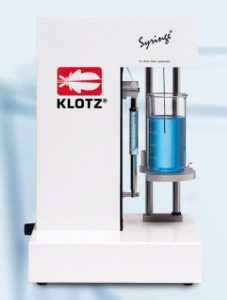
1. Risk of benchmark drift and the possibility of failing the cGMP Audit.
1.1 Consequences of laser sensor calibration drift
After a period of continuous operation involving heating and suction, the laser sensor may become coated with grease or experience optical surface degradation, leading to a deviation in the voltage curve. This deviation causes the device to incorrectly determine the size of suspended particles in the injectable solution.
As a result, the finished product batch was subject to an emergency stockpiling suspension, disrupting the supply chain and causing tens of billions of VND in P&L losses. Furthermore, the factory faces the risk of having its cGMP production license revoked due to the failure to ensure the accuracy of its testing equipment.
(Read more: Managing laboratory chemicals using the Green Lab model reduces new purchase costs by 70%.)
1.2 Based on calibration standards according to the Pharmacopoeia and ISO/IEC 17025
The validation process for liquid particle counters must comply with the stringent regulations of the International Pharmacopoeia. Standards USP 1788(Methods for Determination of Particulate Matter in Injections) and Ph. Eur. 2.09.19 require control of resolution and aspiration error.
According to regulation TCVN ISO 17025, frequency sThe mandatory periodic calibration for optical sensors is every 6 months. Maintaining NIST traceable calibration certificates helps the factory protect the legitimacy of its test results.
2. Procedure for calibrating standard particles in the Pharmacopoeia
2.1 5-Step Hardware Calibration for Klotz Syringe Laser Sensor
To implementCalibration of particle measuring equipment, technicalThe lawyer operates the Calibration Mode. Particle counter in liquidKlotz (Germany) syringes are distributed by Duc Duong. The 5-step digitization process takes place in a closed system according to standards. USP Pharmacopoeia 788:
- Noise Determination: Determine the initial Noise Level (Start Level ~~ 30 mV, Max limit <= 500 mV).
- Calibration Curve Construction: Measure the NIST standard particle sample, and the software automatically determines the peak voltage Vs for particle channel ranges of 1, 2, 5, 10, 15, 25, 50, and 100 µm.
- Resolution Measurement: Measures single-particle scattering, automatically calculates the resolution index Res <= 10% using the formula. USP Pharmacopoeia 788.
- Accuracy Test Volume: Measure the delta mass of distilled water using an analytical balance, and automatically calculate the error in the drawn volume.
- Accuracy Flow Rate Check: Measure the piston movement time to determine the deviation of the linear suction flow rate (mL/min).
(Read more: An efficient wireless temperature data logging solution for laboratories.)
| Calibration Test Index | USP Limit Standard <1788> / Ph. Eur. | Klotz Syringe Assessment Results |
| Background noise voltage | Start Level ~~ 30 mV (Max <= 500 mV) | Meets cleanliness standards (Norm OK) |
| Resolution Index | Res <= 10% for 10 um particles | Automatic calculation based on peak range Vs |
| Accuracy of sample aspiration volume | Volume error +- 1.0 % | Assessment via Delta water volume |
| Suction flow rate accuracy | Flow rate error <= +- 1.0% | Automatic piston timing control |
2.2 Automatically extract FDA 21 CFR Part 11 standard Audit Trail records
The SW-CA 3.0.0 control software fully meets the requirements. FDA standard 21 CFR Part 11Regarding data integrity, all calibration operations, calibration curve adjustments, or pump parameter changes are automatically logged in the Audit Trail log, encrypted with SQL Server.
The 3-tier user access control mechanism (Operator, Service, Admin) combined with electronic signature authentication helps prevent data tampering. Calibration reports are directly exported in PDF/Excel format, giving the QC department complete confidence before cGMP audits.
3. Sterile air isolation Class A during calibration.
3.1 Maintain Class A unidirectional airflow with the DD-ATSH-II-1200 Cabinet
Dust particles from the lab environment falling into the NIST standard bead vial during the operation will cause distortion of the voltage spectrum. This foreign impurity hinders the determination of the Vs peak, ruining the entire curve calibration process.
To completely resolve this risk, Duc Duong manufactured… Class II biological safety cabinet DD-ATSH-II-1200.
The airflow moves in one direction through the UL filter membrane.PA filters out 99.995% of bacteria.Particles from 0.3 µm. The cabinet maintains a sterile working area Class A (ISO Class 5) according to TCVN 8664-1:2011 (ISO 14644-1:1999), providing absolute protection for standard particle bottles.
(Read more: Create a clean work area when handling QC laboratory standards.)
3.2 Controlling cross-contamination protects NIST standard particulate solutions.
The negative pressure differential structure prevents the standard solution from leaking or splashing into the surrounding environment. This feature ensures Biosafety Level II for daily testing personnel.
Perfect isolation helps protect the purity of the standard batch of particles throughout the repeated counting process. Technicians can be completely confident in the precision of the results obtained.
Your company needs advice on regulations.The particle measuring device calibration process achieved cWant to meet ISO/IEC 17025 standards and receive a free IQ/OQ/PQ assessment document set? Click here. Contact Form for Duc Duong CompanyLet our application engineering team provide support right away.
4. Standardize the ultrapure water used for flushing the Calib floor.
4.1 Eliminating blank noise voltage using EVO UP DIO BA
The blank cleaning solution containing micro-ions will generate a background noise level > 500 mV. This high noise level causes the SW-CA 3.0 software to automatically issue error warnings and block the calibration cycle.
Standardized blank water source, distributed by Duc Duong. EVO UP DIO BA ultra-pure water filtration systemofficial channels Mirae ST Korea Official.
Water purification systemThe resistivity is 18.2 MO<sub>mega.cm</sub> at 25°C and TOC < 5 ppb. The Type 1 Water Standard according to TCVN 4851:1989 (ISO 3696:1987) completely eliminates interference potential, enabling the counting of particulate matter in the distillate solution to pass on the first attempt.
4.2 Optimization of the rinsing reaction of the photoelectric sensor membrane
Use ultrapure water in the automatic flushing command.RinseThis helps flush away any remaining microparticles within the optical cell. A clean conduit protects the sensor surface from the risk of fouling.
This mechanism maintains repeatability and reproducibility between calibration curve construction steps. The tester can quickly complete the volume validation measurement.
5. Solutions to dispel the fear of “sensor congestion & failed data audits”
5.1 Backflow command protects LDS sensor.
The biggest fear for lab workers is that the optical cell membrane will become clogged due to the high viscosity of the infusion fluid (Sensor Clog). The Klotz Syringe Pump incorporates a backwashing mode.Backflow) A torrent of reverse force immediately releases any accumulated debris inside the sensor.
At the same time, concerns about failing cGMP audits due to data interference errors are alleviated by digitalized audit trails. All informationCalibrate the particle counter.The u is encrypted and cannot be modified.
5.2 Commitment to readily available spare parts and 24-hour on-site technical support.
Duc Duong eliminates fears of disruption to its inventory clearance plans due to laser sensor failure with its readily available spare parts policy in Ho Chi Minh City. We always have genuine LDS laser sensors and Klotz syringe pistons in stock.
Our team of engineers, knowledgeable in Pharmacopoeia standards, is committed to providing on-site technical support within [timeframe].24 hours. Guaranteed.We ensure that the plant’s sterile testing station always operates stably.
6. The ROI problem and the ISO/IEC 17025 documentation
6.1 The ROI Problem from Internal Self-Calibration Capabilities
When presenting investment budgets to the Board of Directors, the return on investment (ROI) from in-house equipment calibration is the most compelling financial argument. Proactive in-house calibration saves 100% of the annual cost of hiring external calibration services.
More importantly, the system ensures 100% timely delivery of injectable drug batches, eliminating the risk of penalties for contract delays. The project delivers an immediate break-even point (ROI) for the corporation.
6.2 Standardizing the entire ISO/IEC 17025 audit documentation
Duc Duong provides complete Installation Quality (IQ), Operation Quality (OQ), and Performance Quality (PQ) verification documents, along with a Traceable NIST particle calibration certificate. The calibration process is pre-established according to standards. USP Pharmacopoeia 788.
Transparent digitized evidence is ready for use in the rounds.Audit cGMP-EU and TCVN iso 17025. Documentation confirming particle counting capability in sterile solution.It meets international standards.
Conclude
In short, process automationCalibration of particle measuring equipmentThe 5-step digital calibration system is a strategic solution that helps pharmaceutical factories eliminate the risk of laser calibration drift and protect inventory clearance schedules. The synchronized equipment chain, including a Klotz Syringe particle counter (Germany), a DD-ATSH-II-1200 biosafety cabinet, and an EVO UP DIO BA water filtration system, maintains a Class A environment with 99.995% cleanliness, purifies water to Type 1 18.2 MOmega.cm, and automatically constructs a calibration curve achieving USP <1788>. The system completely eliminates the fear of sensor clogging, meets 100% of FDA 21 CFR Part 11 data safety regulations, and completes the ISO/IEC 17025 validation documentation. Duc Duong is proud to be a reputable partner distributing high-quality sterile monitoring equipment through official channels.
Customers who require consultation on planning and self-calibrating sterile labs and wish to receive a quote for genuine equipment sets, please contact and register at DUC DUONG SCIENCE AND TECHNOLOGY COMPANYTo receive attentive service.
FAQ
1. Why does the Klotz Syringe liquid particle counter require periodic calibration?
After a period of operation, the LDS 30/30 laser sensor may experience ground voltage deviation or buildup of grease/viscous solution, leading to calibration drift. Periodic calibration rebuilds the calibration curve, ensuring the counter accurately counts particles invisible to the naked eye according to USP <788>.
2. What are the 5-step calibration procedure for the Klotz Syringe particle counter?
The Pharmacopoeia standard calibration procedure consists of 5 steps: 1. Noise level measurement; 2. Construction of the NIST particle voltage curve (Calibration Curve); 3. Resolution measurement (Resolution <= 10%); 4. Accuracy of sample volume; 5. Accuracy flow rate check.
3. How does the SW-CA 3.0.0 software protect calibration data to meet FDA 21 CFR Part 11 standards?
SW-CA 3.0.0 automatically logs all calibration operations to the Audit Trail log, encrypts SQL Server data, implements a three-tier user access control system (Operator, Service, Admin), and mandates digital signatures. This feature eliminates the risk of data tampering and ensures the security of cGMP audits.
4. What role does the DD-ATSH-II-1200 biological safety cabinet play in the calibration process?
The DD-ATSH-II-1200 cabinet is equipped with a ULPA filter that removes 99.995% of particulate matter >= 0.3 µm, maintaining a Class A (ISO Class 5) unidirectional airflow environment. This ultra-clean air zone prevents environmental dust from entering the NIST standard particle cylinders, eliminating potential errors when constructing calibration curves.
5. What accreditation documents does Duc Duong Company provide for its particle counter that meets ISO/IEC 17025 standards?
Duc Duong provides a complete package of Installation Validation (IQ), Operational Validation (OQ), Performance Validation (PQ) documentation, laser sensor calibration certificates, along with Traceable NIST standard granules that meet Pharmacopoeia standards, and commits to on-site technical support at the factory within 24 hours.