
What is IQ OQ PQ Assessment for Laboratory Autoclaves?
Why might a newly purchased autoclave, despite having complete temperature calibration certificates, still be rejected for official operation by an ISO 17025 auditor? In reality, simply checking for temperature error is insufficient to confirm stable operation under various load conditions.
The confusion between routine calibration and system validation leaves many lab managers perplexed when completing documentation. This article will detail what the IQ, OQ, and PQ standards are according to TCVN ISO/IEC 17025. We will explore how to master the process of controlling pressure and temperature during autoclaving to ensure the safety of all tests.

1. The Importance of IQ, OQ, and PQ in ISO 17025
In quality management, ensuring equipment meets standards is a prerequisite for maintaining objectivity. IQ/OQ/PQ validation is not only an administrative procedure but also scientific evidence of the laboratory's competence.
Equipment Requirements according to TCVN ISO 17025:2017
According to section 6.4.4 of the TCVN ISO/IEC 17025:2017 standard, equipment must be verified to meet the specified requirements before being put into use. This means that we cannot assume that newly purchased equipment will function as advertised; experimental documentation is necessary to prove this.
The IQ/OQ/PQ procedure is a tool that concretizes this "verification" through installation, operation, and actual performance steps. Understanding the principles of the autoclave will help you explain why the pressure and steam parameters require such rigorous validation. Without this documentation, all related test results risk being deemed unsuitable.
2. IQ - Autoclave Installation Qualification
The first stage – Installation Qualification – focuses on verifying that the equipment delivered and installed conforms to the initially agreed-upon technical specifications.
Infrastructure and Technical Documentation Verification
The IQ process requires careful control of the basic infrastructure at the installation site. You need to prepare a detailed checklist to ensure the installation environment does not affect the long-term durability of the autoclave.
Required items include:
Power supply: Verify the voltage (220V or 380V) and check the safety of the grounding system.
Water source: Ensure the water supply is RO water or distilled water to avoid limescale buildup in the sterilization chamber.
Documents: Check all CO/CQ certificates, catalogs, and operating instructions from the manufacturer.
Compare with the SJ-FW100 steam sterilizer series; we need to confirm that the sterilization chamber dimensions are correct (450 x 650 mm) and the power is 3kW, according to the manufacturer's standards at SJ Clane Korea.
3. OQ - Operational Validation and Parameter Control
After successful installation, the next step is to verify that the equipment operates correctly according to the established functions in an unloaded state (empty sterilization chamber).
Automatic Function Testing Procedure
The SJ-FW series features a fully automatic working cycle, including the following stages: Automatic water filling → Heating → Sterilization → Steam release. The OQ (Operating Pressure) phase's task is to ensure these steps run smoothly and that safety warnings are responsive.
The precise control of pressure in the autoclave depends heavily on the machine's PID controller. This controller maintains a stable pressure corresponding to the selected temperature of 121°C or 134°C. For modern machines such as the 103-liter Self-Filling Autoclave, SJ-FW100, from Korea, this control is performed entirely automatically via highly accurate pressure sensors.
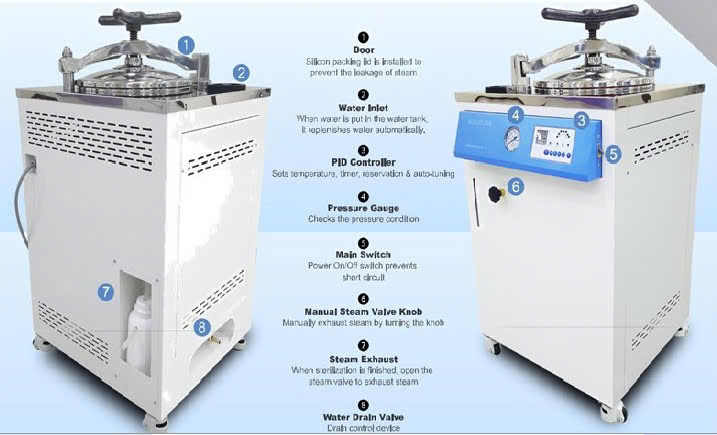
The PID controller (Number 3) of the autoclave plays a crucial role in controlling the temperature accurately
4. PQ - Performance Evaluation with Biological Indicators
This is the most important stage in confirming the effectiveness of the autoclave in killing microorganisms under real-world loading (sample) conditions.
Cold Spot and Biological Indicator Testing
In the PQ step, we place independent temperature measuring devices (Data Loggers) at the most difficult-to-sterilize locations in the autoclave chamber, also known as "cold spots". The goal is to demonstrate that even at these locations, the temperature still reaches the standard threshold to kill all pathogens.
In addition to physical parameters, we need to use biological indicators containing Geobacillus stearothermophilus spores. If, after the sterilization cycle, these indicators are no longer able to grow, it proves that the machine has achieved optimal performance. Before conducting the PQ, make sure you understand the structure of the autoclave to place the sensors in the correct critical locations.
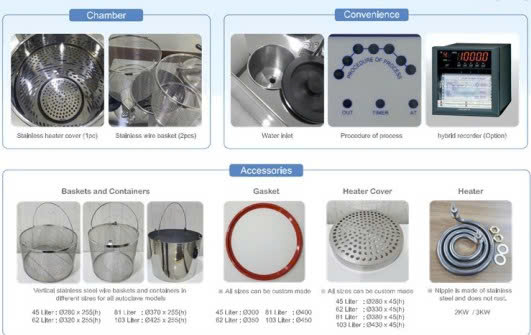
Understanding the structure of an autoclave helps us control the parameters better
5. Supporting Equipment and Validation Services
Performing IQ/OQ/PQ requires standardized measuring equipment and high-level expertise. Laboratories often weigh the options between investing in their own equipment or outsourcing validation services.
Choosing an independent validation unit or performing the validation themselves
Below is a comparison table to help you make a decision that suits your budget and technical requirements:
| Criteria | Self-implementation | Professional service hiring |
| Investment cost | Very high (purchasing standard Data Loggers) | Low (paid per assessment) |
| Legal documentation | Easily questioned objectivity | High reliability, requires professional certification |
| Time | Time-consuming personnel training | Fast and professional implementation |
It is important to note the traceability of the measuring equipment according to ISO 17025 section 6.5 for the documentation to be recognized. You should refer to the 8 questions to answer before installing a steam autoclave to optimize the process from the initial preparation stage.
Conclusion
In summary, the IQ/OQ/PQ documentation is the "passport" confirming the stable operational capability of a modern laboratory. Adherence to this process not only meets the stringent requirements of TCVN ISO/IEC 17025 but also protects the credibility of all research results.
Controlling pressure and temperature through performance validation is the only way to ensure absolute biosafety. If you need detailed advice on validation documentation or are looking for genuine SJ-FW100 autoclaves, please contact Duc Duong for the most comprehensive support.
DUC DUONG SCIENCE AND TECHNOLOGY COMPANY
Address: 1014/67 Tan Ky Tan Quy, Binh Hung Hoa, Binh Tan, HCM
Tel: (028) 3762 8042 - 3762 8043 - 3750 8514 - 3750 8793
Email: ducduong@ducduongco.com
Website: ducduongco.com
ZALO OA: DUC DUONG SCI
6. FAQ - Frequently Asked Questions about IQ OQ PQ (H2)
6.1 What is the difference between IQ/OQ/PQ documentation and safety inspection certificates?
Safety inspections focus on fire and explosion prevention and the mechanical durability of pressure vessels. Meanwhile, IQ/OQ/PQ documentation focuses on demonstrating the quality of the sterilization process and the actual operating capacity of the equipment.
6.2 When is Re-qualification Needed?
Re-qualification is necessary when there is a change in the machine's installation location or after major repairs such as replacing resistors or sensors. Additionally, performance re-qualification (PQ) should be performed annually as part of the maintenance plan.
6.3 Does the SJ-FW100 autoclave support IQ/OQ/PQ documentation?
SJ Clan Korea provides complete technical documentation, drawings, and quality certifications. This foundational data helps users easily build a compliance documentation set for ISO 17025.
Comments
Relative post
- Vacuum Chamber Advanced Solution For Industry
- Benefits of Automatic Water Filling Autoclave
- Korea's Largest Autoclave Manufacturer Shinjineng Participates in Korea Lab 2017 Exhibition
- 3 Phút Khám Phá Ưu Và Nhược Điểm Giữa Phương Pháp Tiệt Trùng Khô Và Tiệt Trùng Hơi Nước
- The 17th Annual International Medical and Pharmaceutical Exhibition in Ho Chi Minh City
- Designing a Laboratory - Basic Requirements